
Mechanical Seal Selection Starts with the Duty
Mechanical seal selection should never begin with a part number alone. The correct starting point is the duty.
A seal must be selected against the full operating environment: process fluid, pressure, temperature, vapour pressure, shaft size, pump type, speed, seal chamber conditions, emissions requirements and maintenance history. In hazardous, flammable or toxic services, the margin for poor selection is narrow. A seal that fits the chamber can still be wrong for the application.
This is where API 682 has practical value. It gives plant teams a structured method for defining the seal, arrangement, support system and documentation package required for critical pump duty. It also helps engineering, maintenance and procurement teams work from the same technical baseline.
For PCS, this is central to reliable pump and mechanical seal support. Mechanical seal performance is not only a product issue. It is linked to specification, installation, repair quality, reconditioning practice, support systems and operating conditions.
API 610 Covers the Pump. API 682 Covers the Sealing System.
API 610 and API 682 are often discussed together, but they do not serve the same purpose.
API 610 applies to centrifugal pumps used in petroleum, petrochemical and natural gas industries. API 682 applies to shaft sealing systems for centrifugal and rotary pumps.
A plant can have a correctly specified pump and still experience poor seal performance if the seal arrangement, piping plan, materials or support system are not suitable for the duty. In refinery, petrochemical and chemical service, the pump and sealing system need to be specified as a connected package.
API 682 supports that process by defining mechanical seal categories, seal types, arrangements, piping plans, qualification requirements and documentation expectations. It brings structure to what can otherwise become a vague replacement request.
API 682 Scope and Operating Context
API 682 Fourth Edition is widely used as a reference for sealing systems in petroleum, natural gas and chemical process applications, particularly where services are hazardous, flammable or toxic.
The operating scope referenced in Flowserve API 682 Fourth Edition material includes:
- temperatures from -40°C to 400°C
- pressures from full vacuum to 40 bar
- shaft sizes from 20 mm to 110 mm
- all speeds
- all viscosities
Although the standard is closely associated with petroleum, natural gas and chemical services, many end users apply API 682 selection logic more broadly where critical pump reliability, containment and documentation control are required.
For South African plants, the value lies in the discipline of the selection process. API 682 helps teams move beyond basic interchangeability and assess whether the seal, arrangement and support system are suited to the actual operating conditions.
Start with the Service, Not the Catalogue
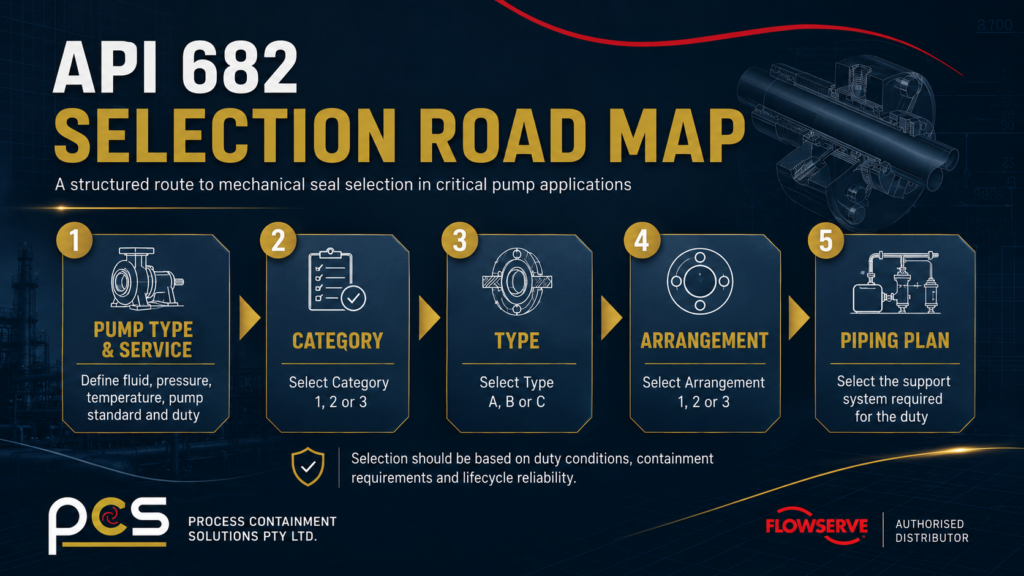
A standards-led selection process should move in sequence:
Pump type and service → Category → Type → Arrangement → Piping plan
This sequence keeps the discussion focused on the application before product selection takes over. The seal hardware, auxiliary system and documentation package must match the risk profile and operating reality of the pump.
Seal Categories
API 682 uses categories to define the application level and documentation expectation.
Category 1 is generally associated with less severe process pump duties, often linked to ASME B73.1 type pump applications.
Category 2 is commonly used for API 610 pump applications where operating conditions, reliability expectations and documentation requirements are more demanding.
Category 3 is specified where the purchaser requires the highest level of qualification, documentation and technical traceability. It is not a default selection. It is normally chosen where the service risk, project requirement or end-user specification justifies the additional documentation burden.
The category decision affects more than paperwork. It influences qualification expectations, inspection requirements, document control and the level of technical evidence required.
Seal Types: Pusher, Bellows and High-Temperature Bellows
API 682 defines three main mechanical seal types.
Type A refers to pusher seals. These use springs to maintain seal face loading and are used across a wide range of process pump applications.
Type B refers to welded metal bellows seals. These designs use the bellows element to provide spring force and accommodate movement, which can be suitable for selected services involving contamination, caustics, dirty hydrocarbons or duties where a non-pusher design is preferred.
Type C refers to high-temperature bellows seals. These are selected for higher-temperature or severe hydrocarbon services where the duty requires a seal architecture suited to elevated thermal demand.
The type selection has a direct effect on the service window of the seal. Temperature capability, pressure range, solids tolerance, coking risk, lubricity and fluid compatibility all need to be considered before the seal family is selected.
Seal Arrangement is a Containment Decision
Once the seal type has been defined, the arrangement must be selected.
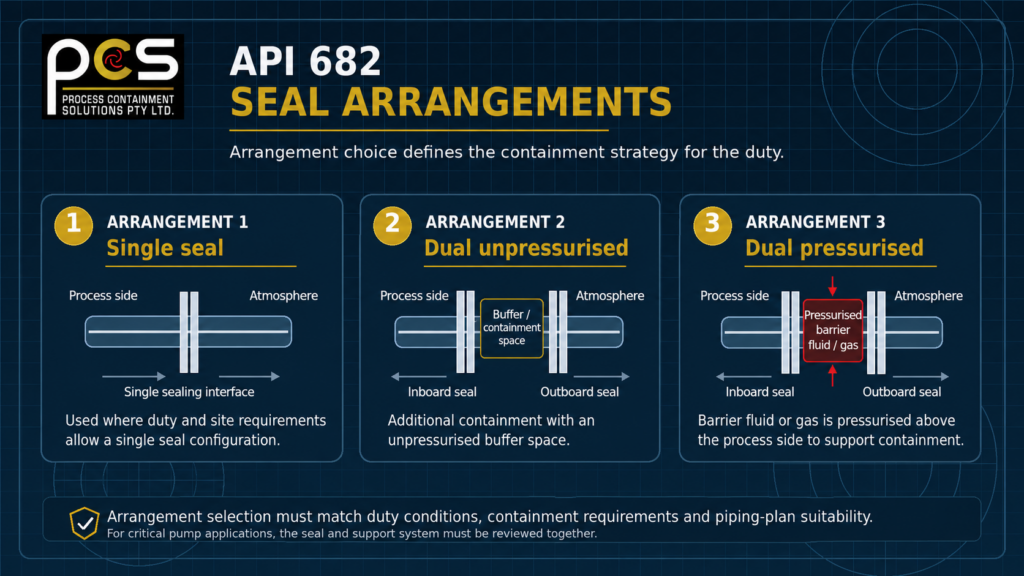
Arrangement 1 is a single seal configuration. It may be suitable where the process, emissions risk and site requirements allow a single sealing interface.
Arrangement 2 is a dual unpressurised seal configuration. It is used where additional containment or backup sealing is required, typically with an unpressurised buffer fluid or gas arrangement.
Arrangement 3 is a dual pressurised seal configuration. It uses a barrier fluid or gas at a pressure above the process side and is selected where the objective is to prevent process leakage to the atmosphere under normal operation.
All mechanical seals rely on controlled leakage at the seal faces for lubrication and heat management. The important question is where that leakage goes, how it is managed, and whether the arrangement is suitable for the process risk. In volatile, hazardous or environmentally sensitive duties, arrangement selection becomes a containment decision, not just a mechanical design choice.
Piping Plans Are Part of the Sealing System
The piping plan is not a secondary item added after the seal has been chosen. It is part of the sealing system.
A mechanical seal can only perform reliably if the environment around the faces is controlled. API 682 piping plans define how the seal is flushed, cooled, pressurised, monitored, quenched or supported. The plan selected can have a direct effect on seal life, emissions control, heat removal and failure risk.
Piping plans may be required to manage:
- solids
- gas entrainment
- heat load
- flashing
- coking or crystallisation
- poor lubricating properties
- toxic or hazardous emissions
- vacuum conditions
- leakage detection
- barrier or buffer fluid control
- instrumentation and monitoring
A well-selected seal can fail early if the support system is wrong, poorly installed or not maintained. For critical pump applications, the seal and piping plan must be reviewed together.
Common API 682 Piping Plan Groups
Different plan groups serve different functions.
Process-side flush and cooling plans such as Plan 11, Plan 21, Plan 23, Plan 31 and Plan 32 are used to manage the seal chamber environment, flush conditions, cooling or solids control, depending on the duty.
Atmospheric-side leakage, quench and detection plans such as Plan 62, Plan 65A, Plan 65B, Plan 66A and Plan 66B help manage leakage detection, quench service or atmospheric-side control.
Dual wet seal support plans such as Plan 52, Plan 53A, Plan 53B, Plan 53C, Plan 54 and Plan 55 define how buffer or barrier fluids are stored, pressurised, circulated and monitored.
Gas containment and barrier plans such as Plan 72, Plan 74, Plan 75 and Plan 76 are used in applications where gas support, containment sealing or vapour management is required.
Where a standard piping plan does not suit the application, Plan 99 allows for an engineered arrangement.
The plan number should never be treated as a small line item on the datasheet. It tells the plant how the seal will be supported in service. Copying a plan from an old installation without checking current process conditions can carry real reliability risk.
Fourth Edition Additions and Instrumentation Focus
API 682 Fourth Edition introduced additional piping plans, including Plan 03, Plan 55, Plan 65A, Plan 65B, Plan 66A, Plan 66B and Plan 99.
The fourth edition also reflects a stronger emphasis on instrumentation. Modern reliability programmes need usable operating data, not only alarm points. Transmitters provide trendable information that can help maintenance and reliability teams monitor support-system behaviour before seal performance deteriorates.
For plant teams, this is a practical development. Seal support systems should not only be installed. They should be visible, measurable and maintained.
Flowserve Seal Families in API 682 Applications
As an authorised Flowserve distributor in South Africa, PCS supports clients with Flowserve ISC2 mechanical seals and other Flowserve sealing technologies across a range of API 682-related applications
Flowserve API 682 reference material maps several product families to recognised seal types and duties.
For Type A pusher seal applications, Flowserve examples include ISC2-682PX, ISC2-682PP, QBQ and QBQLZ.
For Type B welded bellows applications, examples include ISC2-682BX, BX and BXQ.
For Type C high-temperature bellows applications, examples include BXRH, BXHHS, BRCSH and BRC.
For containment and specialised barrier applications, Flowserve examples include GSL, GSDH, GF-200 and GTSP.
These product families should not be treated as interchangeable options. Each seal type and configuration has a defined service window. Flowserve reference data indicates, for example, that ISC2-682PX/PP configurations are used in duties up to 20.6 bar and 204°C, QBQ up to 51.7 bar and 204°C, ISC2-682BX/BB up to 13.8 bar and 204°C, BX/BXQ up to 27.6 bar and 204°C, and BXRH/BXHHS high-temperature bellows designs up to 427°C in the configurations shown.
For more on severe-service metal bellows performance, read the PCS article on BRC seal reliability in severe methanol service.
These figures help narrow the selection range. They do not replace application review. Vapour pressure margin, solids content, fluid compatibility, lubricity, emissions expectations, seal chamber conditions and piping-plan suitability must still be checked.
Questions to Settle Before an RFQ or Repeat Order
Before issuing a request for quotation or approving a repeat mechanical seal order, engineering, maintenance and procurement teams should confirm the application basis.
Key questions include:
- What pump standard and seal chamber are involved?
- Is the duty general process service or API 610 service?
- What are the normal and upset pressures?
- What is the operating temperature range?
- What is the vapour pressure margin?
- Are solids, contamination or crystallisation present?
- What is the fluid chemistry?
- Is Arrangement 1, 2 or 3 required?
- What containment or emissions objective is driving the arrangement?
- Which piping plan will maintain the correct seal environment?
- Who will supply, instrument and maintain the support system?
- What face materials, secondary sealing elements and metallurgy are required?
- Is the requirement for full API 682 compliance, or is an engineered seal outside standard scope being considered for a special duty?
- What documentation, qualification evidence and repair history must accompany the seal?
These questions are just as relevant to repeat purchases as they are to new projects. A like-for-like replacement can still be the wrong decision if the process has changed, the operating envelope has shifted, the support system has deteriorated or a previous failure review showed that the original selection was unsuitable.
What a Repair File Should Capture
Standards-led thinking also improves repair quality.
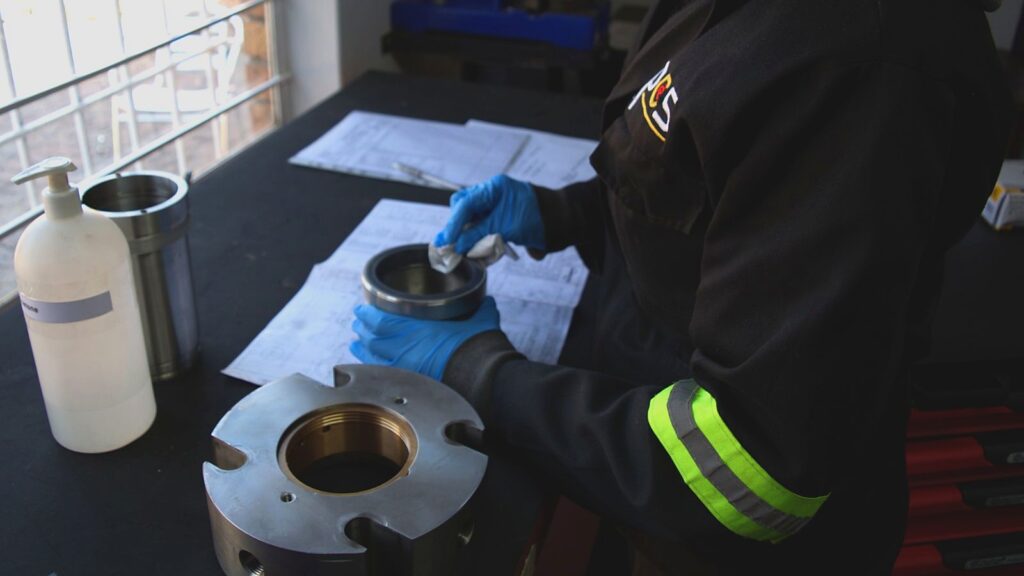
PCS provides mechanical seal repair services that include inspection, reporting, reconditioning and rebuild work. In critical pump services, repair should not be limited to replacing worn components and returning the seal with a test certificate. The repair file should help the plant understand what failed, why it failed, and whether the original selection and support system remain suitable.
A useful repair and failure-assessment record should capture:
- seal face condition
- evidence of flashing, coking, dry running or solids ingress
- secondary sealing element condition
- sleeve and gland dimensions
- condition of bushings or containment elements
- signs of heat generation
- evidence of incorrect flush or barrier conditions
- relevant support-system and instrumentation observations
- repair scope and replacement components
- final inspection and test records
In mechanical seal repair, the rebuilt component is only part of the value. The greater value lies in connecting the failed condition to the duty, arrangement, piping plan and operating environment. That is how repair work contributes to long-term reliability rather than simply returning hardware to service.
Why This is Relevant to South African Plants
South African petrochemical, chemical, mining, water, manufacturing and power generation operations run critical rotating equipment under demanding conditions. Unplanned seal failures can quickly affect production continuity, safety exposure, environmental control and maintenance cost.
For these plants, API 682 is useful because it creates a practical basis for better mechanical seal decisions. It helps teams define the arrangement, support system, documentation and repair expectations needed for the application.
PCS supports this process through Flowserve mechanical seal supply, seal selection guidance, mechanical seal repair, pump reconditioning and failure assessment. This gives engineering and maintenance teams a local technical partner that can connect specification, supply, repair and reliability support.
The objective is not to select the most complex sealing system by default. The objective is to select the correct system for the duty.
PCS Support for API 682 Mechanical Seal Selection
Process Containment Solutions (PCS) supports South African industry with Flowserve mechanical seal solutions, pump reconditioning, mechanical seal repair and technical support for demanding process applications.
In critical pump services, mechanical seal reliability depends on the full sealing system: seal type, arrangement, piping plan, materials, documentation, repair quality and operating conditions. API 682 gives structure to those decisions. PCS supports the practical application of that structure in South African plant environments.
For plants reviewing API 682 requirements, mechanical seal selection, piping plan suitability, recurring seal failures, pump reconditioning or mechanical seal repair, PCS can assist with technical support and Flowserve seal supply for critical pump applications.
____________
Need support with API 682 mechanical seal selection, Flowserve seal supply, pump reconditioning or mechanical seal repair in South Africa?
Speak to PCS about standards-led mechanical seal support for critical pump applications.