Industrial Pump Repairs Across South Africa
PCS supports industrial pump repair requirements across South Africa through regional technical contacts and established repair capability.
Pump condition, application duty, failure evidence, mechanical seal and bearing condition, repair history and technical feasibility are considered when defining the appropriate repair scope.
South Africa-Wide Support
Pump repair enquiries are supported across all nine South African provinces through PCS regional technical contacts.
Regional Technical Contacts
Enquiries are directed to the appropriate PCS contact according to location, pump type and repair requirement.
Approved Flowserve Repairer
PCS is an Approved Flowserve pump and mechanical seal repairer.
Repair and Testing Support
Assessment, refurbishment and functional testing are provided according to the equipment and agreed repair scope.
Pump Repair Support Across South Africa
Industrial Pump Repair Support Across South Africa
Process Containment Solutions (PCS) supports industrial pump repair enquiries from customers throughout South Africa through regional technical contacts.
Customers can discuss pump condition, known failure symptoms, application requirements and equipment location with the appropriate PCS representative before the next step is determined.
Depending on the equipment and agreed scope, pump repair support may include condition assessment, mechanical seal and bearing review, component refurbishment or replacement, controlled reassembly and functional testing where required.
Regional Technical Contact Areas
Pump repair enquiries are coordinated nationally and directed to the appropriate PCS representative according to location and requirement.
- Gauteng, North West, Limpopo, Free State & Export Enquiries Gareth +27 (0)10 442 5798 gareth@pcsza.com
- KwaZulu-Natal Chris +27 (0)31 902 1220 chris@pcsza.com
- Western Cape Brandon +27 (0)76 696 6990 brandon@pcsza.com
- Mpumalanga Nicolene +27 (0)82 861 5345 nicolene@pcsza.com
- Northern Cape Rudolph +27 (0)79 785 0880 rudolph@pcsza.com
- Vaal Triangle Gareth +27 (0)10 442 5798 gareth@pcsza.com
Contact the PCS national line and your pump repair enquiry will be directed to the appropriate representative.
Pump Repair Assessment
What PCS Assesses During an Industrial Pump Repair
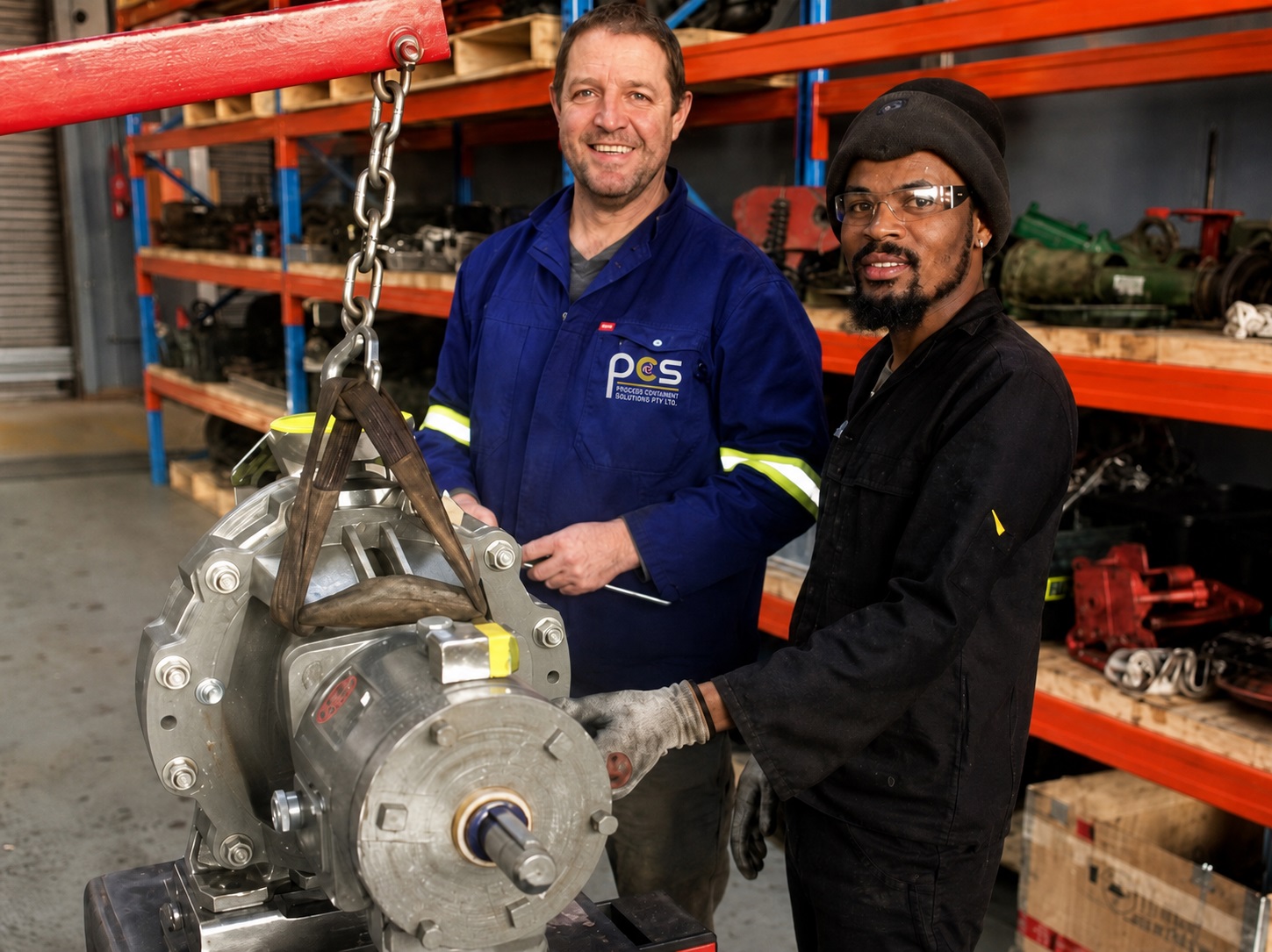
The appropriate repair scope depends on the pump type, equipment condition, application duty, failure evidence, repair history and customer requirements. Depending on the equipment and agreed scope, PCS may assess the wider pump assembly rather than only the component that has visibly failed. Where seal condition forms part of the repair requirement, PCS can also provide mechanical seal repair support .
Initial Inspection and Controlled Disassembly
Visible damage, wear patterns, component condition and available failure evidence are reviewed as the pump is inspected and disassembled.
Dimensional and Component Assessment
Assessment may include the casing, impeller, shaft, sleeve, wear areas, bearing fits and other repair-critical dimensions.
Mechanical Seal and Bearing Review
Mechanical seal condition, bearing condition, bearing housing, lubrication evidence, contamination and possible contributing factors may be considered. Where bearing isolation or contamination control is relevant, review the available information on bearing-protection requirements .
Repair Scope and Testing Requirements
Repairability, component requirements, refurbishment or replacement options, controlled reassembly, quality checks and functional testing are considered according to the agreed scope.
The exact inspection, repair and testing process depends on the equipment, repair findings, application requirements and customer specification.
Repair or Replacement
Should the Pump Be Repaired or Replaced?
The decision should not be based on repair cost alone. Pump condition, application duty, failure history, component availability, mechanical seal and bearing condition, testing requirements and lifecycle considerations should all form part of the assessment.
When Continued Repair Remains Technically Viable
Repair may be considered when the pump remains suitable for its application and the damage can be addressed within an appropriate repair scope.
- Major components remain serviceable and damage is localised or repairable.
- The pump still matches the required duty, including the process media and operating conditions.
- Suitable components or refurbishment options are available.
- Mechanical seal and bearing concerns can be addressed as part of the repair.
- The repair supports continued viable operation when cost, lead time and operational risk are considered.
When Repair May No Longer Address the Reliability Risk
Replacement or re-selection may need consideration where damage, repeated failure or changes in the process duty affect the continued suitability of the pump.
- Major components are severely damaged or repair feasibility is limited.
- Failures are recurring and previous repairs have not resolved the wider problem.
- Process conditions have changed and the pump no longer suits the application.
- Parts are obsolete, unavailable or impractical to source.
- Repeated repair cost and operational exposure make continued repair commercially difficult to justify.
Key Factors That Inform the Decision
Damage, wear patterns and serviceability of major components.
Whether the failure is isolated, recurring or becoming more frequent.
Current flow, pressure, process media and operating conditions.
Availability of suitable parts, refurbishment options and technical support.
Whether component failures point to a wider pump or application condition.
Whether an appropriate repair scope can be defined and completed.
Repair cost, maintenance burden, parts availability, continued service value and MTBR and MTBF reliability tracking where sufficient maintenance data is available.
Criticality, downtime exposure and return-to-service requirements.
Pump Repair Capability
Industrial Pump Repair Capability for Demanding Applications
Process Containment Solutions (PCS) assesses industrial pump repair requirements according to pump type, equipment condition, application duty, failure evidence and technical feasibility. The appropriate repair route and scope are defined according to the equipment, application requirements and available findings.
Centrifugal Process Pumps
Repair assessment for centrifugal pump configurations used in industrial process, water, manufacturing and general plant applications.
Chemical Process Pumps
Assessment of pump condition, wetted components, mechanical seals and repair feasibility for chemical process applications. View related information on Flowserve Durco chemical process pumps .
Slurry Pump Applications
Repair consideration for pumps exposed to abrasive media, wear and demanding operating conditions, subject to equipment assessment. Explore related heavy-duty slurry pump applications .
Magnetic Drive and Sealless Pumps
Technical assessment of magnetic drive and sealless pump configurations, including relevant containment and component considerations.
Positive Displacement Pumps
Repair support for applicable positive displacement pump configurations, including gear, lobe, diaphragm and related pump types, subject to assessment.
Other Industrial Pump Configurations
Vertical, horizontal and other industrial pump configurations may be considered according to pump condition, application duty, component availability and technical feasibility.
Structured Pump Repair Process
A Controlled Repair Process Based on the Equipment and Duty
Process Containment Solutions (PCS) follows a structured pump repair process to support informed repair and replacement decisions. Depending on the pump type, equipment condition and agreed scope, the process may include inspection, controlled disassembly, dimensional assessment, mechanical seal and bearing review, repair-scope definition, component refurbishment or replacement, controlled reassembly, quality checks and functional testing.
Initial Inspection and Controlled Disassembly
Visible damage, wear patterns, component condition and available failure evidence are reviewed as the pump is received, inspected and disassembled.
Dimensional and Component Assessment
Shaft condition, impeller wear, casing condition, wear areas, bearing fits and other repair-critical dimensions may be assessed.
Mechanical Seal and Bearing Review
Mechanical seal condition, bearing condition, compatibility, lubrication evidence, contamination and possible contributing factors are considered where relevant.
Repair Scope Recommendation
Repairability, replacement parts, refurbishment options, material considerations and whether repair or replacement is more suitable are reviewed.
Reassembly and Quality Checks
Controlled reassembly, component fit, sealing interfaces, alignment-related considerations and repair documentation are completed according to the agreed scope.
Functional Testing
Where required and applicable, testing is selected according to the pump, repair scope, customer specification and application requirements.
Testing May Include
Functional testing does not replace correct inspection and repair assessment. It supports return-to-service confidence by confirming that relevant aspects of the agreed repair have been checked before the pump is released.