
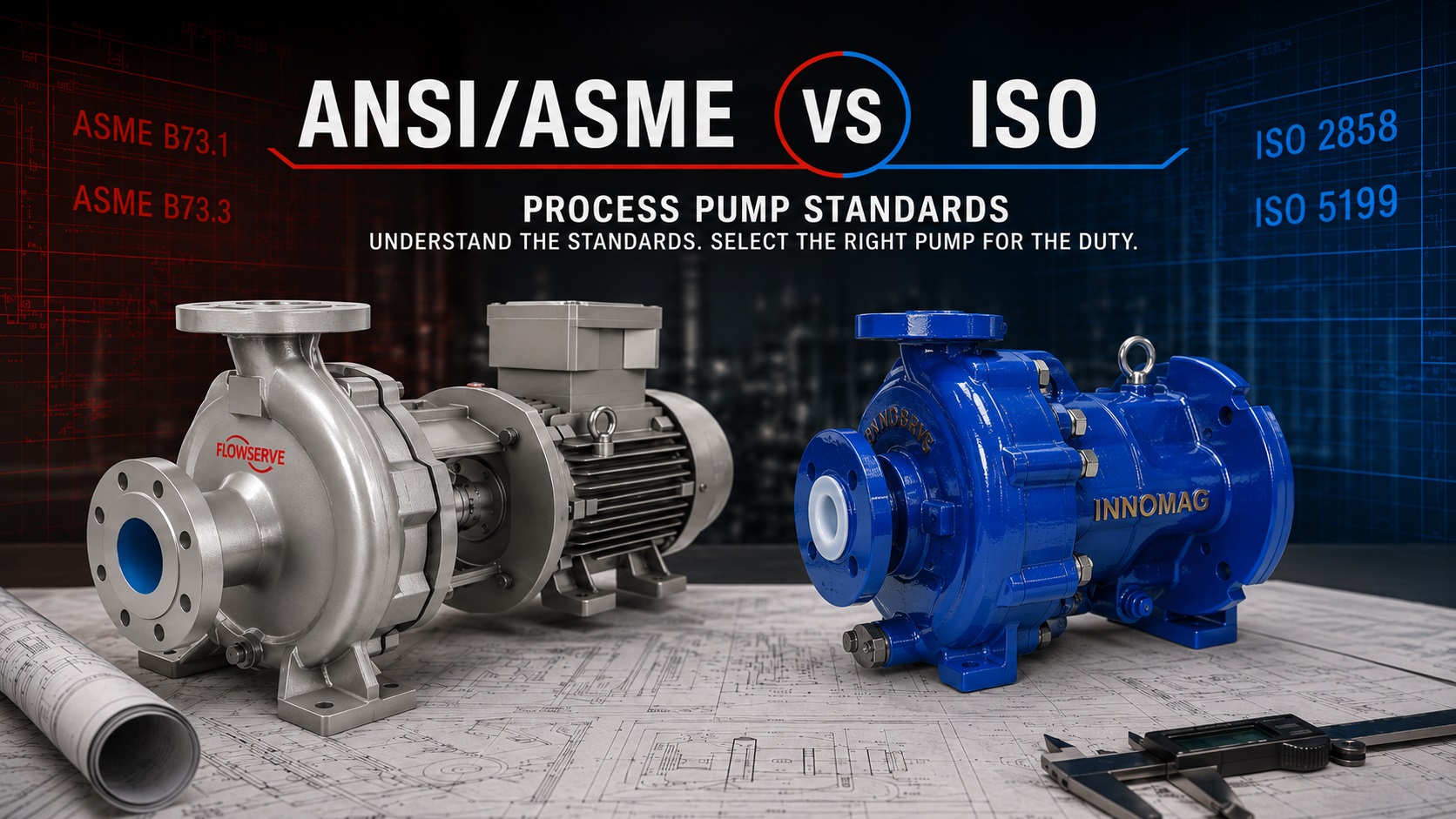
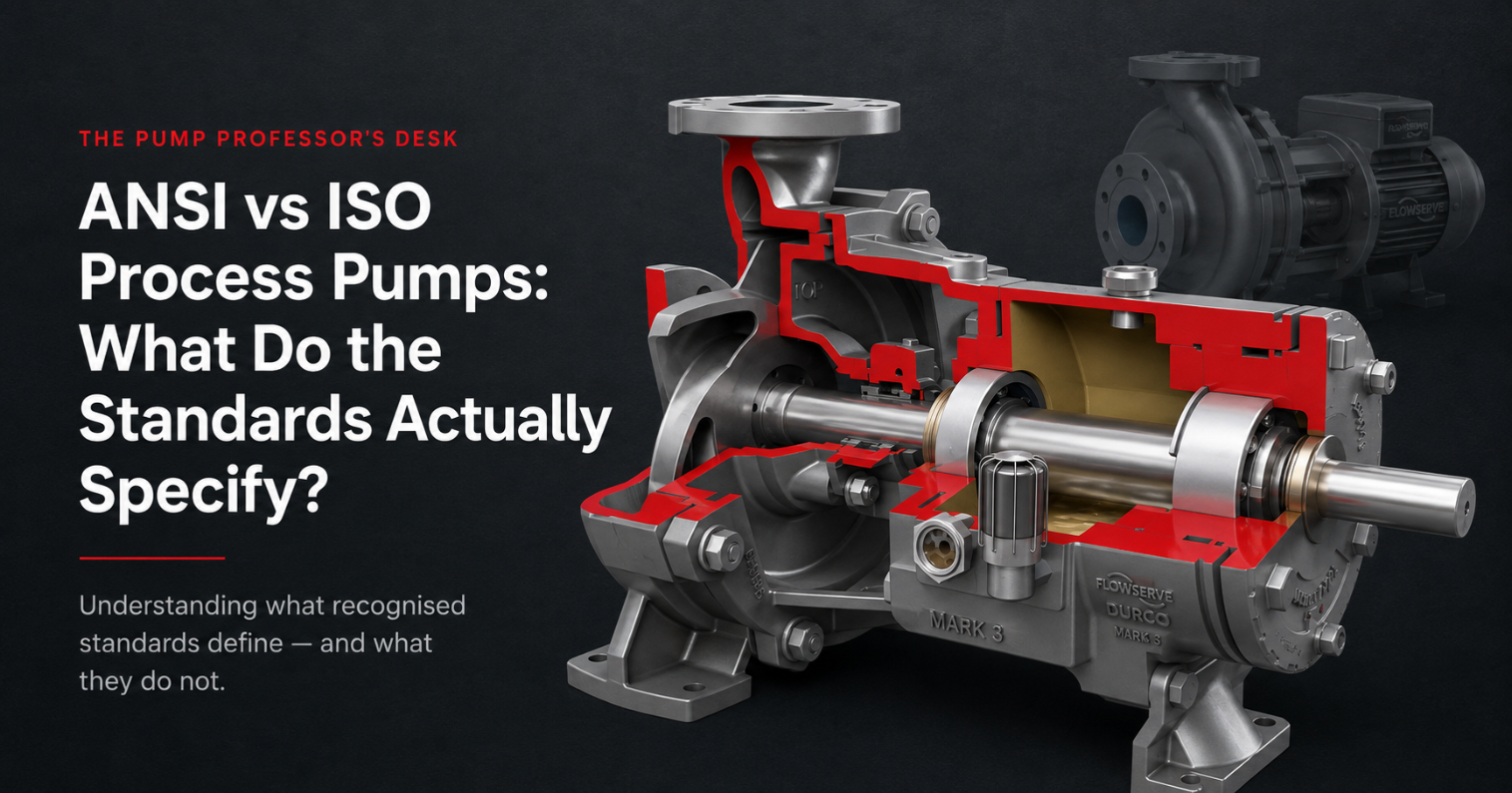
When a process pump specification calls for an “ANSI pump” or an “ISO pump”, the terminology can make the requirement sound straightforward. In practice, these descriptions refer to recognised engineering standards that define particular aspects of pump design, dimensions and technical requirements.
For engineers, maintenance teams and technical procurement, understanding what those standards actually provide is important.
A recognised standard gives the buyer a defined engineering reference. It does not replace application engineering, but it reduces ambiguity around the aspects of the pump that are expected to conform to an agreed specification.
That engineering certainty can be valuable when selecting new equipment, standardising installed pump populations or planning future replacement and maintenance.
It is equally important to understand what the standard does not provide.
Compliance with an ANSI/ASME or ISO process-pump standard does not automatically make a pump suitable for a particular process duty, nor does it guarantee efficiency or reliability in every installation.
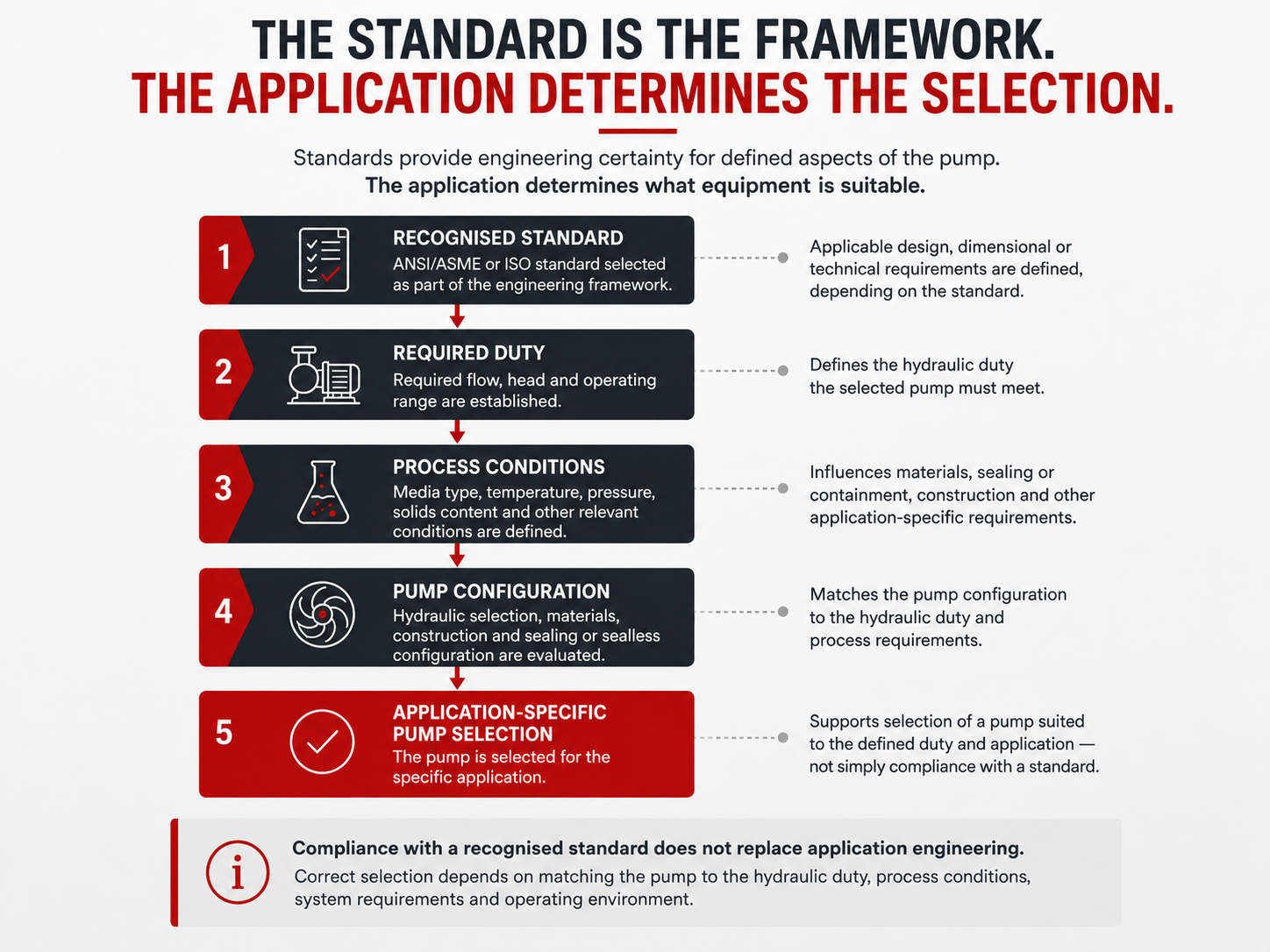
The standard provides the engineering framework. The application still determines the selection.
What is meant by an ANSI process pump?
“ANSI pump” remains common terminology throughout the process industries, particularly when referring to horizontal end-suction centrifugal pumps used in chemical and related process applications.
The more technically precise reference is the ASME B73 family of standards.
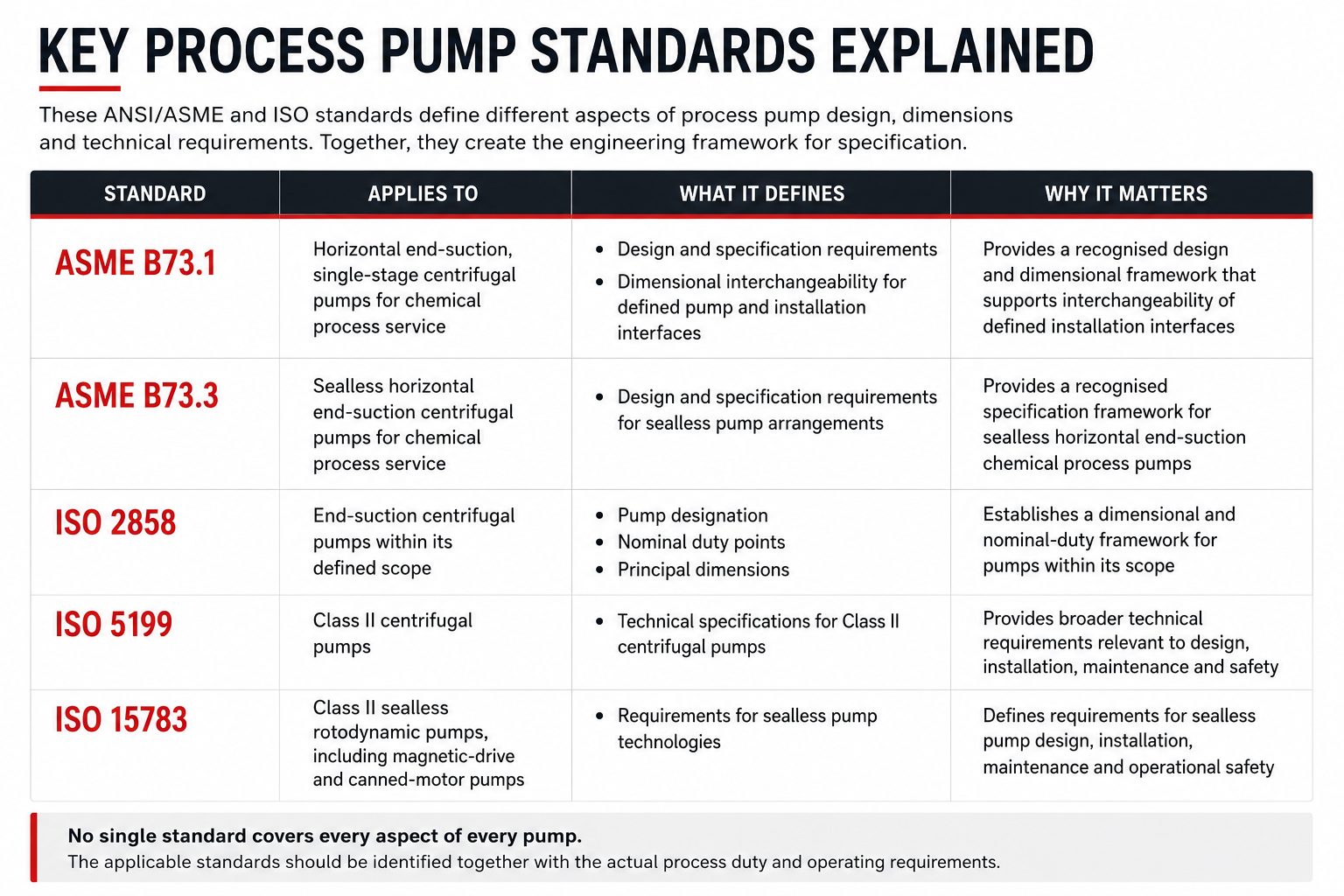
ASME B73.1 addresses horizontal end-suction, single-stage centrifugal pumps for chemical-process service. It establishes design and specification requirements and includes dimensional interchangeability requirements covering defined pump and installation interfaces.
These requirements are relevant to matters such as mounting dimensions, nozzle size and location, input shafts, baseplates and foundation arrangements.
For an industrial plant, this degree of standardisation can provide practical value. It creates a known dimensional and design framework against which pumps can be specified and assessed.
ASME B73.3 addresses sealless horizontal end-suction centrifugal pumps for chemical-process applications.
This becomes particularly relevant where magnetic-drive or other sealless process-pump technologies are being considered.
What is meant by an ISO process pump?
The term “ISO process pump” also needs some qualification because no single ISO document defines every aspect of every process pump.
Several standards may form part of the specification.
ISO 2858 applies to defined end-suction centrifugal pumps and establishes pump designation, nominal duty points and principal dimensions.
ISO 5199 provides broader technical specifications for Class II centrifugal pumps.
For sealless rotodynamic pumps, ISO 15783 addresses Class II sealless pump technologies including magnetic-drive and canned-motor arrangements.
The ISO framework therefore separates different elements of process-pump specification across relevant standards rather than relying on one document to define every requirement.
For engineering and procurement teams, this distinction is important. Specifying an “ISO pump” without identifying the applicable technical requirements may not provide enough information to select the equipment correctly.
The important point is that these standards should not be treated as simple product labels.
They establish recognised engineering references against which defined aspects of a pump can be designed, specified and assessed.
This provides a more controlled basis for communication between the purchaser, engineer, manufacturer and technical supplier.
Why does standardisation matter in a process plant?
The value of standardisation is not that every pump becomes identical.
Its value is that certain requirements become defined rather than assumed.
Depending on the standard and the equipment involved, this can create greater certainty around areas such as:
- pump configuration;
- principal dimensions;
- installation interfaces;
- nozzle arrangements;
- nominal duty information;
- specified mechanical requirements;
- information that must be agreed between purchaser and supplier.
This can assist when developing equipment specifications, comparing technically suitable alternatives, planning replacement equipment or standardising parts of an installed pump population.
For technical procurement teams, this is particularly important.
Two pumps may appear capable of producing the same flow and head, but that does not mean that they conform to the same dimensional, mechanical or technical requirements.
The standard helps establish a defined basis for that comparison.
Standards provide certainty, not a blanket performance guarantee
This is one of the most important distinctions when specifying an industrial process pump.
A recognised standard provides engineering certainty around the requirements covered by that standard.
If a pump is specified to comply with a particular standard, the purchaser has an established engineering reference against which those aspects of the product can be assessed.
This reduces ambiguity.
It provides clearer expectations between the purchaser and manufacturer about what has been specified and what the equipment is expected to conform to.
What it does not do is guarantee that a pump will perform reliably simply because a standard appears on the specification sheet.
Standards compliance does not remove the need for correct:
- sizing;
- hydraulic selection;
- material selection;
- installation;
- operation;
- maintenance.
Nor does it guarantee that equipment will be suitable for every fluid or operating condition that may occur in the plant.
The manufacturer can engineer and manufacture equipment against a recognised specification.
The actual process duty still needs to be correctly defined.
This distinction matters because an accurately manufactured pump can still be the wrong pump for an application if the duty, media or operating conditions have been incorrectly specified.
Does a process-pump standard define efficiency?
Efficiency should also be separated from standards compliance.
Recognised process-pump standards can establish requirements relating to design, dimensions, nominal duty and technical specification. A standard designation alone does not determine how efficiently a particular pump will operate once installed.
Actual hydraulic efficiency depends on the selected pump hydraulic, the required flow and head, pump speed and where the unit operates relative to its performance curve.
System conditions also matter.
A correctly specified process pump should therefore be evaluated against the real operating duty rather than selected simply because it carries an ANSI/ASME or ISO designation.
This distinction is important when comparing equipment.
Two pumps conforming to the same recognised standard may still have different hydraulic characteristics or be selected differently for the same system.
The standard provides the engineering framework.
Hydraulic selection determines how the pump addresses the required duty.
How do standards relate to pump reliability?
The same principle applies to reliability.
An ANSI/ASME or ISO designation should not be interpreted as a promise that a pump will run reliably under any operating condition.
Standardisation can, however, support good reliability decisions by providing a more controlled basis for equipment specification, design requirements and installation interfaces.
Reliable operation still depends on the complete pumping system and actual process duty.
Relevant factors may include:
- hydraulic selection and operating point;
- process fluid characteristics;
- pressure and temperature;
- materials of construction;
- solids or abrasive content;
- mechanical seal or sealless configuration;
- available NPSH;
- installation and alignment;
- bearing and lubrication conditions;
- maintenance practices;
- equipment condition and operating history.
This also matters when repeated pump or mechanical seal failures are being investigated.
Replacing equipment with another pump carrying the same standard classification will not necessarily correct a problem caused by operation outside the intended duty, unsuitable material selection, system conditions or another underlying cause.
Standardisation supports the engineering process.
It does not replace failure assessment or application engineering.
What does the standard not decide?
The name of the pump standard is only one part of a complete specification.
Application-specific engineering decisions may still be required around:
- required flow and head;
- process media;
- corrosiveness;
- abrasiveness;
- viscosity;
- solids concentration;
- operating pressure;
- temperature;
- available NPSH;
- materials of construction;
- mechanically sealed or sealless configuration;
- mechanical seal requirements where applicable;
- motor and drive requirements;
- installation conditions;
- maintenance requirements.
Dimensional compatibility should also not automatically be interpreted as complete equipment interchangeability.
A replacement pump must still meet the hydraulic duty, suit the process media and be appropriate for the operating conditions.
“ANSI” or “ISO” should therefore be the start of the technical specification rather than the entire specification.
How these standards appear in actual process-pump platforms
Real process-pump ranges provide useful examples of how these engineering frameworks are applied.
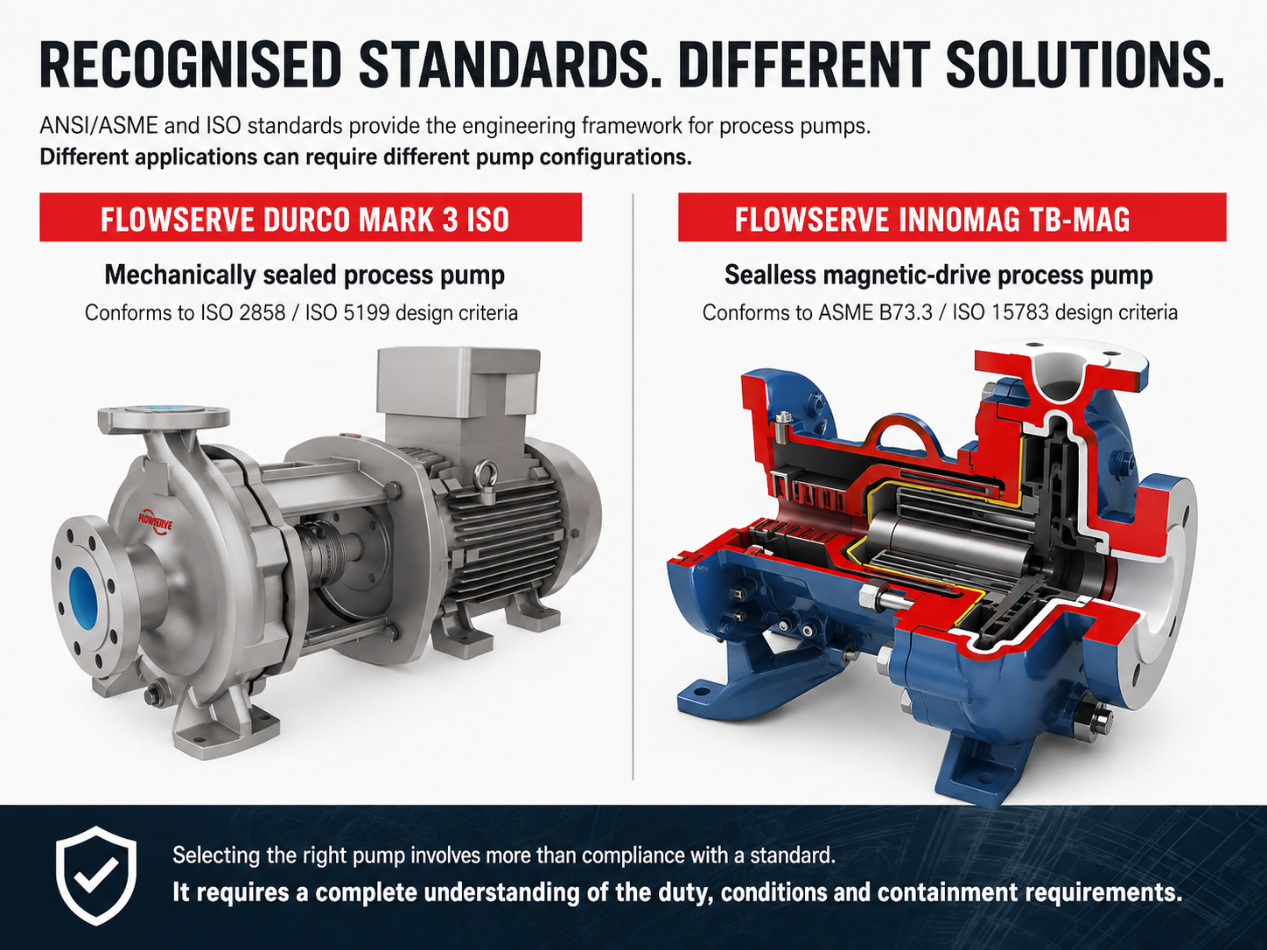
The Flowserve Durco Mark 3 ISO chemical process pump range is developed around ISO process-pump requirements. Flowserve documentation identifies mechanically sealed Durco Mark 3 ISO pumps as conforming to ISO 2858 and ISO 5199 design criteria.
The range also illustrates why compliance with a recognised standard does not eliminate application-specific selection. Pump configuration, hydraulic selection, materials and sealing arrangements can still vary according to the requirements of the process.
The Flowserve INNOMAG TB-MAG provides a useful sealless example.
The fluoropolymer-lined magnetic-drive process pump is available within recognised ASME and ISO process-pump specification frameworks, illustrating how sealess technology can be selected while retaining the dimensional or technical requirements applicable to the plant specification.
These examples highlight the relationship between standardisation and application engineering.
The standard defines the relevant engineering framework.
The pump configuration still needs to address the actual duty.
Specifying the standard and the application
For engineering and procurement teams, the practical conclusion is straightforward:
“ANSI” or “ISO” should not be the end of a process-pump specification.
The applicable standard should be identified together with sufficient information to evaluate the actual operating duty.
This provides the manufacturer and technical supplier with a clearer basis from which to assess the application and select the appropriate equipment.
Process Containment Solutions (PCS) supports industrial clients with process-pump selection, fluid-control products, pump repair capability and technical support. As an Authorised Flowserve Distributor within South Africa, PCS can assist with assessing process requirements and selecting appropriate Flowserve pump technologies where applicable.
The objective should not simply be to specify a pump that conforms to a recognised standard.
It should be to specify the correct pump, to the appropriate standard, for the actual process duty.