Why Engineering Support After Installation Is a Critical Reliability Factor
Across mining, petrochemical, water treatment, and manufacturing plants, pump and fluid-handling system performance depends on more than product selection or installation quality. Long-term reliability relies on structured after-sales technical support, and industry data consistently validates this.
Studies of rotating equipment and process systems show that organisations with strong post-installation support have lower failure rates, fewer unplanned stoppages, and longer asset lifecycles than plants without ongoing technical oversight.
This article breaks down the key insights behind those findings and explains why after-sales support is a non-negotiable component of pump system reliability.
1. Commissioning Support Reduces Early-Life Failures
A significant portion of pump failures occur in the early stages of operation. Industry reliability studies show that incorrect commissioning remains one of the most common contributors to premature breakdowns, particularly related to:
- Misalignment
- Incorrect lubrication
- Poor suction conditions
- Incorrect seal installation
- Pump operating off-curve
Why support matters
Experienced technicians verify alignment, confirm hydraulic conditions, and ensure the pump operates within its design envelope. This minimises early wear and sets the baseline for long-term performance.
2. Ongoing Technical Support Reduces Unplanned Downtime
Operational data from industrial plants shows unplanned downtime is significantly higher in systems without scheduled technical intervention.
Common preventable failures include:
- Bearing degradation
- Cavitation
- Seal deterioration
- Impeller wear
- Motor inefficiency
Impact of after-sales support
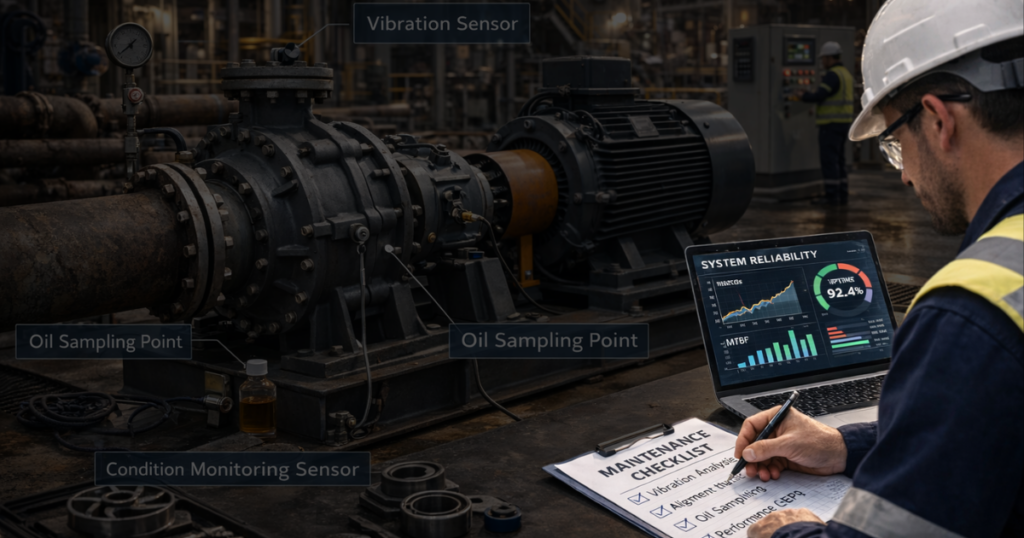
Routine diagnostics, vibration monitoring, periodic alignment inspections, and hydraulic performance reviews help detect early deviations before failure occurs. Plants with well-organised support programmes consistently achieve higher uptime and lower repair costs.
3. Updated System Assessments Improve Energy Efficiency
Energy waste in pumping systems frequently derives from:
- System changes over time
- Incorrect control valve settings
- Wear-related hydraulic losses
- Pumps operating far from their Best Efficiency Point (BEP)
What the data shows
Post-installation system assessments help plants maintain energy performance. Combined with ISO-aligned energy audits, many facilities achieve measurable energy reductions by correcting avoidable inefficiencies.
4. Spare Parts Planning Extends Asset Life
Unplanned failures regularly lead to rushed procurement, incorrect parts, or poor-quality replacements.
After-sales support benefit
Technical teams keep accurate spare parts lists, ensure correct material compatibility, and verify the availability of critical components. Plants with structured spares management have shorter repair times and fewer repeat failures.
5. Training and Knowledge Transfer Reduce Operational Errors
Many failures are operational rather than mechanical. The data shows a recurring challenge:
- Operators may unintentionally run pumps at unstable flow ranges
- Incorrect start-up or shutdown procedures cause stress on equipment
- Lubrication routines may be inconsistent or incorrect
Why support matters
After-sales technical support often includes operator training to ensure the system is operated safely and efficiently. Plants that invest in training report fewer operational incidents and improved reliability metrics.
6. Lifecycle Monitoring Improves Capital Planning
Engineering teams that track pump performance over time identify trends that influence capital expenditure planning:
- Wear rate patterns
- Seal life expectancy
- Motor efficiency degradation
- System curve changes
Outcome
This supports data-informed decisions on repair versus replacement, ensuring capital is allocated with reliability, safety, and lifecycle cost in mind.
7. Increased Reliability = Measurable ROI
Across industries, the data confirms a direct link between after-sales support and reduced lifecycle cost.
Plants with structured technical support commonly achieve:
- Lower mean time between failures (MTBF)
- Reduced emergency maintenance
- Fewer catastrophic breakdowns
- Optimised energy use
- Longer asset service life
The result is a clear, measurable return on investment through improved uptime and reduced total cost of ownership.
After-Sales Support Is Not a Service, it’s a Reliability Strategy
High-performance pumps and containment systems are only as reliable as the support behind them. Real-world data shows plants that rely on ongoing technical expertise experience more stable operations, longer asset lifespans, safer working conditions, and lower overall maintenance expenditures.
PCS provides engineering-driven after-sales support, including:
- Diagnostics and vibration analysis
- System performance assessments
- Laser alignment and commissioning
- Preventive maintenance planning
- On-site troubleshooting
- OEM-aligned repair services
Our support extends far beyond installation, ensuring every system continues to deliver safe, reliable and efficient performance over its lifecycle.