
FMECA-Based Prevention Strategies for Industrial Pump Reliability
Unplanned pump failures are among the most costly challenges in mining, petrochemical, water treatment, manufacturing, and power generation. Unscheduled downtime disrupts production, increases maintenance costs, and creates safety risks. A formal approach, such as Failure Modes, Effects, and Criticality Analysis (FMECA), provides engineering teams with a proven framework for identifying where pump systems are most vulnerable and for lessening those risks before they lead to breakdowns. This guide covers the eight most common pump failure modes, their root causes, and how FMECA strategies can reduce risk, extend service life, and support continuous plant uptime.
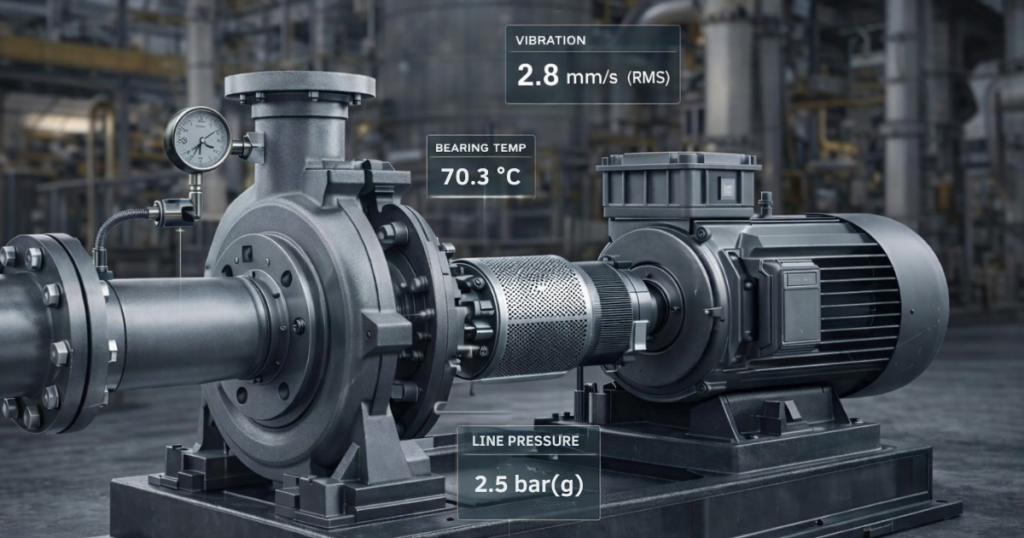
1. Bearing Failure
Bearings are high-criticality “sacrificial” components in rotating equipment. In modern plants, degradation is often caused by environmental contamination or electrical issues rather than simple wear.
Common Causes:
- Incorrect alignment between the pump and motor.
- Lubrication contamination (dust/moisture) or incorrect lubrication intervals.
- Stray electrical currents: Particularly in VSD-driven pumps without proper shaft grounding, leading to “fluting” or pitting.
- Excess axial or radial load from operating off-curve.
FMECA Prevention Strategies:
- Implement condition-based lubrication and Oil Analysis to detect wear metals ($Fe, Cu, Al$) early.
- Use Desiccant Breathers to prevent moisture ingress in humid or dusty South African mining environments.
- Add vibration and temperature monitoring for real-time deterioration alerts.
- Conduct precision laser alignment after any maintenance or motor replacement.
2. Mechanical Seal Failure
Mechanical seals are often the first point of failure in process pumps. In the petrochemical sector, seal failure is a primary “containment” risk.
Common Causes:
- Dry running or improper venting.
- Incorrect seal material selection for chemical concentration or operating temperature.
- Inadequate flush plans: Failure to maintain the seal environment.
FMECA Prevention Strategies:
- Assess process fluid properties to ensure face material compatibility (e.g., Silicon Carbide vs Tungsten Carbide).
- Utilise API 682 Standard Flush Plans (e.g., Plans 11, 21, or 53) to ensure the seal environment is cooled and lubricated.
- Install flow or pressure interlocks to prevent catastrophic dry-run events.
3. Cavitation
Cavitation occurs when vapour bubbles collapse against the impeller, causing “sponge-like” pitting and severe performance loss.
Common Causes:
- Suction Cavitation: Insufficient Net Positive Suction Head (NPSHa) relative to Required (NPSHr).
- Discharge Cavitation: Operating too far to the left of the Best Efficiency Point (BEP).
- Blocked suction strainers or partially closed valves.
FMECA Prevention Strategies:
- Verify system NPSH margin during both design and commissioning phases.
- Install pressure sensors on suction lines to detect early deviations.
- Educate operators on the sound of “pumping gravel,” a hallmark sign of cavitation.
4. Impeller Damage
Impellers are prone to erosion and imbalance, especially in abrasive slurries or chemically aggressive environments.
Common Causes:
- Solids carry-over in mining slurry applications.
- Material Mismatch: Using standard steel for corrosive fluids.
- Prolonged cavitation or “off-design” operation.
FMECA Prevention Strategies:
- Select metallurgy or coatings (e.g., High-Chrome Iron or Duplex Stainless) based on fluid pH and abrasion index.
- Schedule periodic visual inspections and record wear rates to predict replacement intervals.
- Utilise filtration systems where solids ingress is not part of the design.
5. Shaft Misalignment
Misalignment is a silent killer that accelerates wear on every other component, including bearings, seals, and couplings.
Common Causes:
- Improper initial installation or foundation settling.
- Thermal Growth: Failure to account for metal expansion in high-temp power generation or petrochem applications.
- Pipe strain (the burden of the piping resting on the pump casing).
FMECA Prevention Strategies:
- Use laser alignment tools for exact cold setup.
- Perform “Hot Alignment” checks once the pump reaches operating temperature.
- Inspect piping supports and utilise flexible connectors to eliminate casing stress.
6. Motor or Electrical Failure
Pump reliability is tightly bound to the health of the drive system.
Common Causes:
- Voltage imbalance or poor power supply quality.
- Harmonics: Electrical interference from Variable Speed Drives (VSDs), causing heat buildup.
- Insulation breakdown due to moisture or overheating.
FMECA Prevention Strategies:
- Implement real-time motor condition monitoring (MCMA).
- Conduct power-quality reviews to determine grid instability at the plant.
- Verify VSD programming to ensure the motor isn’t hunting or operating in a resonance zone.
7. Lubrication Issues
Lubrication is the lifeblood of the pump. Even the highest quality bearing will fail quickly with the wrong grease or oil.
Common Causes:
- Mixing incompatible lubricant bases.
- Over-lubrication (causing heat buildup) or under-lubrication.
- Contamination from high-pressure washdowns or dust.
FMECA Prevention Strategies:
- Develop a strict lubrication management plan in line with OEM and ISO standards.
- Use automatic lubrication systems for critical, hard-to-reach assets.
- Implement oil sampling to detect contamination before mechanical wear begins.
8. Structural or Casing Failure
While less frequent, casing failures are high-severity events that can lead to fires or environmental disasters.
Common Causes:
- Water Hammer/Hydraulic Surge: Sudden pressure spikes from valve closures.
- Thermal shock from rapid fluid temperature changes.
- Corrosion-induced wall thinning.
FMECA Prevention Strategies:
- Install pressure-relief or surge-suppression systems (e.g., bladder tanks).
- Utilise Non-Destructive Testing (NDT), such as ultrasonic thickness testing, to verify casing integrity.
- Ensure casing materials are rated for both the chemical concentration and the maximum surge pressure.
How FMECA Enhances Long-Term Pump Reliability
FMECA provides engineering teams with a clear, evidence-based approach to failure prevention:
- Risk Prioritisation: Focuses budget and manpower on the components with the highest “Risk Priority Number.”
- Predictive Integration: Aligns vibration and thermal data with specific failure modes.
- Lifecycle Optimisation: Ensures the pump functions within its specified design limits (BEP).
Building an Active Reliability Culture
Pump failures seldom occur without warning. Through understanding the root causes and applying a structured FMECA methodology, South African industrial operations can significantly enhance reliability and plant uptime. Process Containment Solution (PCS) supports industrial operations across Southern Africa with accurate pump diagnostics, engineered repairs, and system optimisation. We help you move from reactive “firefighting” to proactive reliability.
For pump assessments or to discuss reliability-driven maintenance strategies, visit pcsza.com or contact the PCS team today.