Industrial pumps operate continuously in demanding environments across mining, petrochemical processing, water treatment, and manufacturing plants. When pump failure occurs unexpectedly, the consequences can include production downtime, environmental risk, and costly equipment damage.
In most cases, pump failure does not occur without warning. Increased vibration levels, rising bearing temperatures, seal leakage, or declining discharge pressure often indicate underlying mechanical or hydraulic issues.
Understanding the most common industrial pump failure modes allows maintenance teams to identify early warning signs and implement preventative maintenance strategies that improve equipment reliability and extend pump service life.
Reliability engineering tools such as Failure Modes, Effects and Criticality Analysis (FMECA) help identify potential failure points and prioritise corrective action before failures escalate.
Why Industrial Pumps Fail
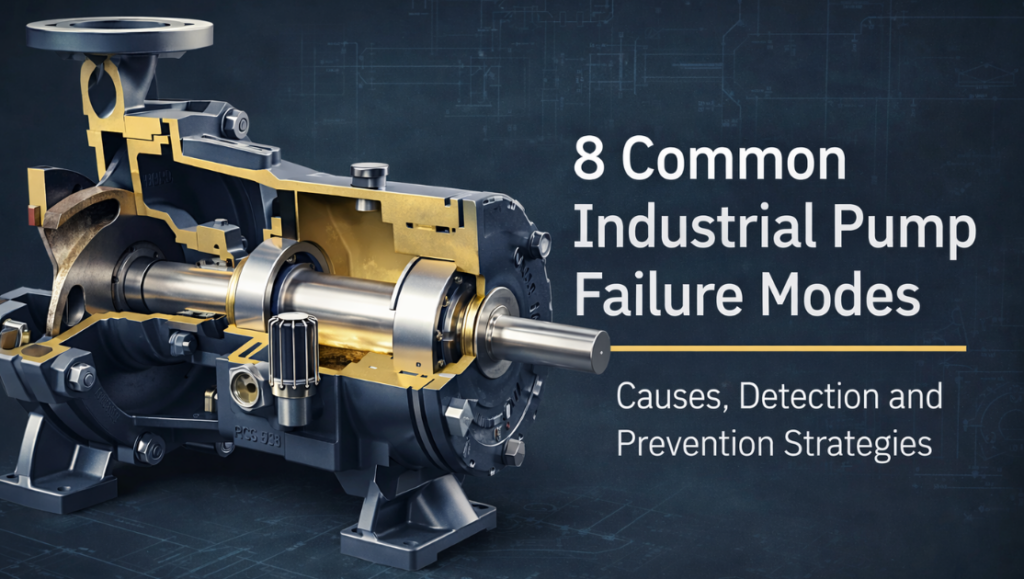
Industrial pump failures generally fall into four primary categories:
- mechanical component wear
- hydraulic instability
- operational errors
- inadequate maintenance practices
Understanding these failure mechanisms allows plant engineers to detect early symptoms and prevent catastrophic equipment damage.
1. Bearing Failure
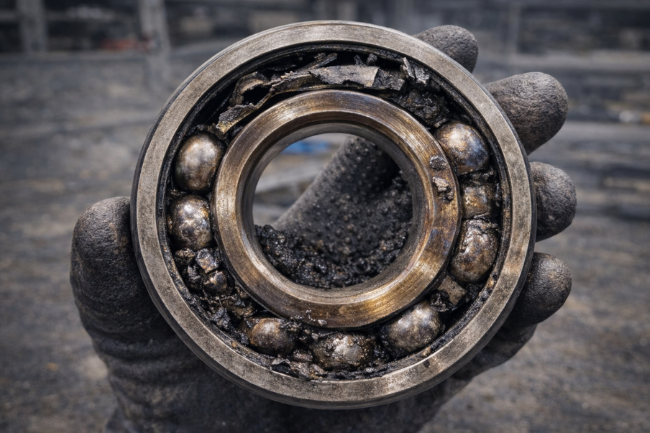
Bearing failure is one of the most common causes of industrial pump breakdown.
Bearings support the rotating shaft and impeller assembly. When lubrication conditions deteriorate or mechanical loads increase beyond design limits, bearing wear accelerates rapidly.
Common Causes
- contaminated lubrication oil
- shaft misalignment
- excessive vibration
- improper installation
Detection Indicators
Maintenance teams typically detect bearing problems through:
- vibration monitoring
- increased bearing temperature
- abnormal mechanical noise
Prevention
Preventive measures include:
- scheduled lubrication maintenance
- vibration monitoring programmes
- correct shaft alignment during installation
2. Mechanical Seal Failure
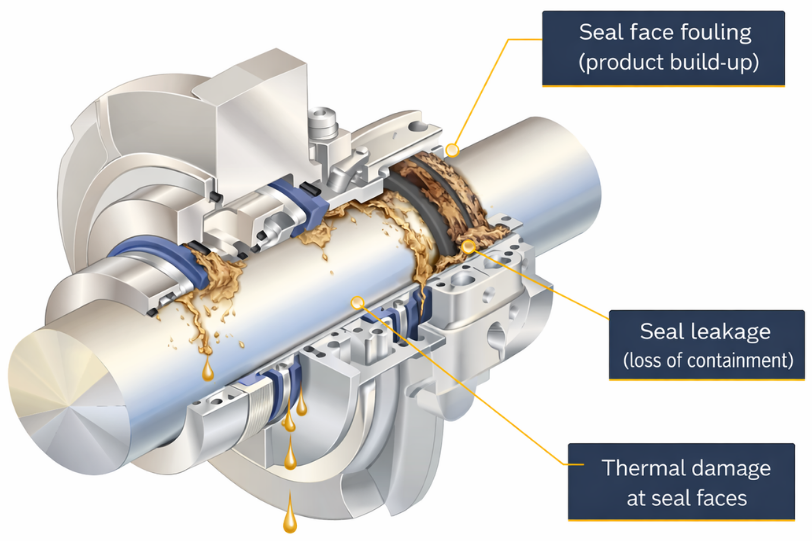
Mechanical seals prevent process fluids from leaking along the pump shaft. In demanding industrial environments, seal reliability is critical for maintaining containment integrity and preventing product loss.
Causes
Mechanical seal failure often results from:
- dry running conditions
- abrasive solids in the pumped media
- incorrect seal material selection
- poor lubrication
Detection
Early signs include:
- visible leakage around the seal housing
- elevated seal chamber temperatures
- abnormal vibration patterns
Prevention
Seal reliability improves when:
- the seal type matches the pumped fluid
- adequate lubrication is maintained
- pumps operate within their design parameters
3. Cavitation
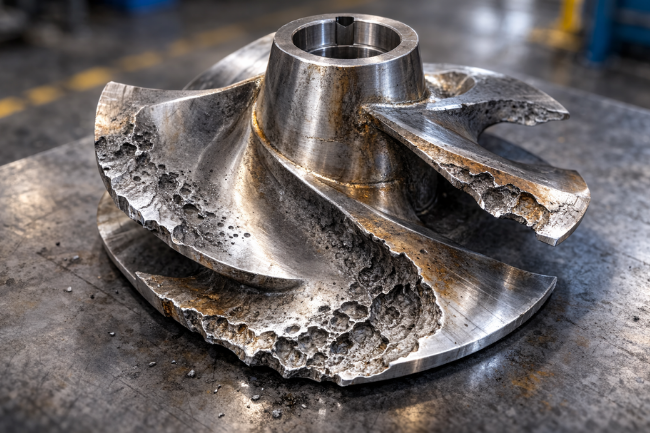
Cavitation occurs when pressure within the pump drops below the vapour pressure of the liquid, causing vapour bubbles to form and collapse rapidly.
When these bubbles collapse near metal surfaces, they generate intense localised forces that damage pump components.
Consequences
Cavitation typically results in:
- impeller pitting
- increased vibration
- reduced pump efficiency
- noise resembling gravel or rattling
Prevention
Preventing cavitation requires careful system design and proper pump selection.
Key strategies include:
- maintaining adequate Net Positive Suction Head (NPSH)
- ensuring proper suction piping configuration
- avoiding excessive pump speeds
4. Impeller Wear
Impellers transfer energy to the pumped fluid. When abrasive solids are present in the fluid, erosion can progressively damage impeller surfaces.
This is particularly common in:
- slurry transport systems
- mining operations
- wastewater treatment plants
Effects
Impeller wear leads to:
- reduced hydraulic efficiency
- increased energy consumption
- decreased flow capacity
Prevention
Material selection plays an important role in improving durability.
Wear-resistant alloys and coatings are commonly used in abrasive pumping applications.
5. Shaft Misalignment
Shaft misalignment places excessive stress on bearings and mechanical seals.
Even small alignment errors can significantly shorten equipment life.
Causes
Misalignment typically occurs due to:
- improper installation
- foundation movement
- thermal expansion
Prevention
Laser alignment tools allow maintenance teams to achieve precise shaft alignment during installation and routine maintenance.
6. Dry Running
Dry running occurs when a pump operates without sufficient fluid flow.
This can rapidly overheat mechanical seals and damage internal components.
Common Causes
- blocked suction lines
- incorrect pump priming
- operator error
Prevention
Monitoring systems and operational safeguards help ensure pumps maintain proper fluid flow during operation.
7. Lubrication Failure
Proper lubrication is essential for maintaining bearing performance and reducing friction between moving components.
When lubrication degrades or becomes contaminated, bearing wear accelerates significantly.
Prevention Strategies
- oil condition monitoring
- scheduled lubrication replacement
- contamination control
8. Pump Overheating
Operating a pump outside its designed duty point can generate excessive heat.
Restricted flow conditions or excessive system pressure often contribute to overheating.
Effects
Overheating may result in:
- seal degradation
- bearing damage
- premature component wear
Maintaining correct operating conditions is critical to preventing thermal stress within pump systems.
The Role of FMECA in Pump Reliability
Failure Modes, Effects and Criticality Analysis (FMECA) is widely used in reliability engineering to evaluate potential failure scenarios within industrial equipment.
By identifying critical components and assessing failure likelihood, maintenance teams can prioritise preventative actions that reduce unplanned downtime.
Applying structured reliability analysis improves:
- equipment availability
- maintenance efficiency
- operational safety
Industrial Pump Reliability Support
Process Containment Solutions (PCS) provides technical support for pump reliability across mining, chemical processing, water treatment, and manufacturing industries.
Services include:
- pump diagnostics and inspection
- repair and refurbishment
- component replacement
- reliability optimisation
By identifying early signs of failure and implementing preventative maintenance strategies, industrial operators can significantly reduce downtime and extend equipment service life.
Contact PCS to schedule a reliability assessment.